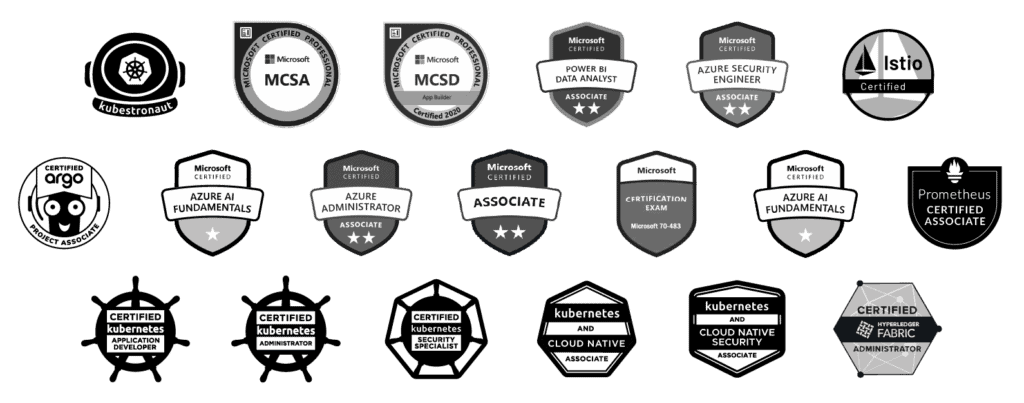
Embracing Cutting-Edge Technologies
Artificial Intelligence and Machine Learning
Artificial Intelligence (AI) and Machine Learning (ML) are revolutionizing custom software development. These technologies enable applications to learn from data, make intelligent decisions, and improve over time. AI and ML are being used to enhance predictive analytics, automate repetitive tasks, and provide personalized user experiences. Developers must integrate AI and ML into their solutions to stay competitive and meet the growing demand for intelligent applications. By integrating AI and ML, Veritas Automata offers
cutting-edge solutions that drive innovation, optimize operations, and enhance security, positioning our clients for success.
Blockchain and Hyperledger Fabric - Immutable Records Technology
- Blockchain: Blockchain is a distributed ledger technology that allows data to be stored across a network of computers. It consists of a series of blocks, each containing a list of transactions. Blockchain is widely known for underpinning cryptocurrencies like Bitcoin, but is also used in various industries for secure and transparent record keeping.
- Hyperledger Fabric: Hyperledger Fabric is an open-source project under the Hyperledger umbrella, hosted by Linux. It is a specific implementation of blockchain technology designed for enterprise use. It features modular architecture and, unlike public blockchains, is a permissioned blockchain, meaning the participants in the network are known and vetted, enhancing security and trust. It uses chaincode (smart contracts) written in general-purpose programming languages like Java and JavaScript, to execute business logic. Hyperledger Fabric is used in a variety of industries for applications that benefit from blockchain’s immutability and transparency but require the control and security of a permissioned network. Examples include supply chain tracking and digital identity..
- Immutable Records: Immutable Records refer to data that, once written, cannot be changed or deleted. This concept is central to the security and trustworthiness of blockchain technology. In the context of blockchain, immutability is achieved through the cryptographic linking of blocks. Each block contains a hash of the previous block, making it practically impossible to alter any data without altering the entire chain and gaining network consensus. Immutable records are essential for applications that require high levels of trust and security.
Blockchain is no longer just synonymous with cryptocurrencies. It is transforming various industries by offering secure, transparent, and decentralized solutions. Custom software development is leveraging blockchain for applications that require robust security, such as supply chain management, healthcare records, and financial transactions. At
Veritas Automata, we utilize Hyperledger Fabric’s immutable records to enhance the security and transparency of our solutions. Understanding how to incorporate blockchain and Hyperledger Fabric into your projects can provide a competitive edge and address critical security concerns.
Internet of Things (IoT)
The Internet of Things (IoT) connects devices, systems, and services, creating a network of interconnected objects. IoT is driving innovation in custom software development by enabling real-time data collection, analysis, and automation. From smart homes to industrial automation, IoT applications are becoming more prevalent. Developers must focus on creating software that can seamlessly integrate with IoT devices and deliver enhanced functionality and user experiences. By utilizing IoT technology, Veritas Automata provides innovative solutions that improve safety and security, optimize resource usage, and enable smarter decision-making.
Adopting Innovative Methodologies
Agile and DevOps
Agile and DevOps methodologies are no longer optional—they are essential for modern software development. Agile promotes iterative development, continuous feedback, and collaboration, ensuring that projects remain flexible and responsive to change. DevOps integrates development and operations, enabling faster deployment, improved quality, and enhanced collaboration. Embracing these methodologies can significantly improve your development processes and deliver better software faster. At Veritas Automata, we employ Agile and DevOps methodologies to enhance software development processes, which enables us to break down silos and ensure seamless integration and delivery of software.
Microservices Architecture
Microservices architecture is reshaping how custom software is developed and deployed. Unlike traditional monolithic architectures, microservices break down applications into smaller, independent services that can be developed, deployed, and scaled independently. This approach enhances flexibility, scalability, and maintainability. Developers must master microservices to build resilient and scalable software solutions that meet the demands of modern businesses.
Veritas Automata leverages Microservices Architecture to enhance the development, deployment, and scalability of our applications. Each microservice can be developed, tested, and deployed independently, which allows us to release new features or updates to individual services without impacting the entire system. We also employ Continuous Integration and Continuous Deployment (CI/CD) pipelines to automate the building, testing, and deployment of microservices. This ensures that new code is consistently integrated and tested, leading to faster and more reliable releases.
Serverless Computing
Serverless computing is gaining traction as a way to simplify development and reduce infrastructure management. By abstracting server management, developers can focus on writing code and deploying functions that scale automatically based on demand. This shift is particularly beneficial for applications with variable workloads. Understanding serverless computing can help developers create cost-effective and scalable solutions.
Veritas Automata utilizes Serverless Computing to build scalable, cost-efficient, and highly responsive applications. We design applications that respond to specific events, such as HTTP requests, file uploads, database changes, and message queue updates. Using platforms like
AWS and Azure, Veritas Automata develops small, single-purpose functions that execute in response to these events, enabling a highly responsive and modular architecture. Serverless platforms automatically scale the computer resources up or down based on demand. Veritas Automata benefits from this by ensuring that our applications can handle varying loads without manual intervention, also known as dynamic scalability. Unlike traditional server-based infrastructure, there are no costs associated with idle resources in a serverless environment, further optimizing operational expenses.
The Future is Here
Low-Code and No-Code Development
Low-code and no-code platforms are democratizing software development by enabling non-developers to create applications with minimal coding. These platforms use visual development environments and pre-built templates to accelerate development. While they are not a replacement for traditional development, they offer opportunities for rapid prototyping and development of simpler applications. Staying informed about these platforms can provide strategic advantages and expand development capabilities. Low-code and no-code platforms allow Veritas Automata to rapidly prototype and develop applications. Drag-and-drop interfaces, pre-built components, and templates enable quick assembly of applications without extensive coding. These platforms facilitate rapid prototyping and iterative development, enabling Veritas Automata to quickly test ideas, gather feedback, and make necessary adjustments.
Quantum Computing
Quantum computing is on the horizon, promising to solve complex problems that are currently infeasible for classical computers. While still in its early stages, quantum computing has the potential to revolutionize fields such as cryptography, optimization, and simulation. Developers should keep an eye on advancements in quantum computing and consider how it might impact future software development.
Staying Ahead of the Curve
Are you ready to lead? Staying ahead requires embracing the latest trends and innovations. By integrating cutting-edge technologies like AI, blockchain, and IoT, adopting innovative methodologies such as Agile and DevOps, and preparing for future advancements like quantum computing, you can ensure your software solutions remain competitive and relevant. The future of custom software development is bright, and those who adapt and innovate will thrive.
We want to equip you with the knowledge to harness the future of custom software development, driving success and innovation in your projects.
Get in touch to learn more!